Women’s subordination and oppression
The Second SexWomen’s subordination and oppression names the condition in which women, though autonomous human subjects, are made to occupy an inessential position in a world organized around male authority. Its force lies not in an unchanging feminine nature but in the interaction of law, religion, custom, economic dependence, and daily labor. The analysis traces how these arrangements restrict women’s freedom and access to an open future, while insisting that the situation can change when women gain the means to act for themselves.
Definition and Philosophical Stakes
The account rejects the idea that femininity is a fixed essence, whether rooted in biology or preserved as an eternal ideal. Biological and social characteristics do not establish an immutable definition of woman; they take meaning within a concrete situation. Nor is it enough to declare women simply human beings in the abstract: each person is situated, and women cannot honestly claim to stand outside the conditions attached to their sex. The problem is not that women lack subjectivity, but that their subjectivity is interpreted and constrained through a social order that treats men as the norm.
The philosophical distinction between transcendence and immanence explains what is at stake. Every subject seeks to exceed the given through projects and movement toward an open future. When a person is confined to repetition and treated as a fixed object, freedom is diminished: imposed confinement becomes frustration and oppression, while acquiescence in it becomes a moral failure. Women’s particular predicament is that they remain autonomous freedoms while being compelled to assume the status of the Other, so that their actions and aspirations are subordinated to another consciousness. The conflict between a subject’s claim to be essential and a situation that makes her inessential frames the inquiry into how women can achieve independence within dependence.
Historical and Institutional Formation
The argument locates subordination in the unequal relations between groups, rather than in a natural hierarchy. When two groups meet, each may seek sovereignty; where one has an advantage, it can impose and maintain oppression. Physical strength could matter in conditions of danger and rudimentary tools, but it does not by itself explain the enduring authority of men. The account places particular weight on social arrangements that made men’s power durable and defined women’s position through male-controlled institutions.
The supposed golden age of women’s rule is treated with caution. Images of powerful mothers and goddesses may preserve memories of women’s elevated status, but symbolic power is not the same as reciprocal social authority. Even when a woman is revered as Earth, Mother, or Goddess, she may remain outside the circle of human peers and political authority. The argument distinguishes that exalted yet exceptional figure from a woman recognized as another subject. Women have instead been made part of the goods exchanged between men: marriage establishes relations between male groups through women, rather than necessarily creating reciprocity between women and men.
Law, theology, philosophy, and literature have helped turn male supremacy into something that appears eternal or divinely ordained. Male lawmakers and religious authorities have invoked women’s supposed weakness to justify restrictions, while stories and moral judgments have converted social arrangements into apparent truths about female character. Such arguments frequently serve male interests: the account notes, for example, that the Roman code invoked women’s alleged fragility when a weakening family structure made women a perceived threat to male heirs. Religious and philosophical authorities likewise furnished justifications for women’s subordinate condition. In this analysis, inherited ideas about womanhood are not neutral descriptions; they can function as defenses of the arrangements that produced women’s dependence.
Reproductive Labor and Unequal Time
The account connects women’s subordination to the division between reproductive functions and activities recognized as projects. Giving birth and nursing are treated as natural functions rather than, by themselves, projects that confer social authority. In early nomadic societies, where children could be regarded as burdens and survival was uncertain, childbirth did not necessarily provide women with pride or permanence. As domestic responsibilities became bound to motherhood, women were assigned labor that repeated itself without producing a recognized new world.
By contrast, the figure of man as maker is associated with activities that project beyond immediate necessity. Making tools, constructing dugout canoes, hunting, and fishing are presented as ways of altering the world, setting ends, and opening a future. The contrast is not that women are inherently incapable of creation, but that social arrangements confer value on activities culturally marked as masculine while confining women to maintenance. The exclusion from dangerous public action also matters in the argument: social prestige is attached to risking life in pursuit of collective ends, rather than to bearing life. The hierarchy thus turns a division of activities into a hierarchy of human worth.
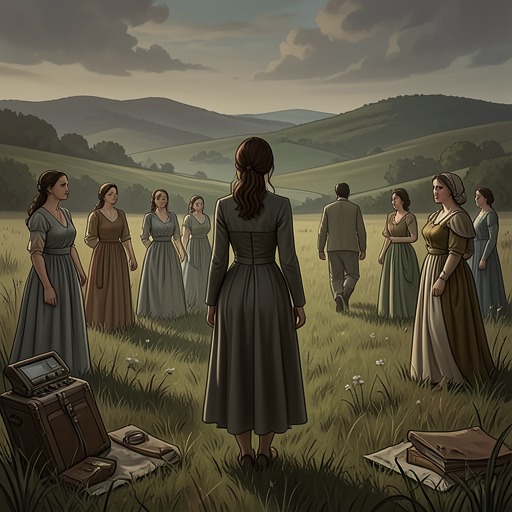
The same unequal distribution of time appears in the account of the French peasant woman. Her responsibilities could include tending the garden and animals; cleaning, sowing, plowing, hoeing, harvesting, and gathering grapes; preparing meals; and washing and mending. Her day begins at dawn with feeding animals and serving the first meal, continues through childcare and field or household work, and extends into evening tasks such as cleaning and mending. Pregnancy and childcare add further burdens, while lack of time for health contributes to illness and premature exhaustion. Although she may share her husband’s interests and responsibilities, and may even hold considerable moral authority in the household, she lacks the leisure available to men who go to town, meet companions, visit cafés, or hunt and fish. The distinction between household respect and practical freedom remains stark.
Housework makes the same structure visible in a more general form. Its tasks recur precisely because their completion does not end the need to repeat them: dishes must be washed again, furniture dusted again, and clothes mended only to become dirty, dusty, or torn. The housewife struggles against deterioration rather than achieving a lasting positive result, so each day starts the cycle anew. The comparison to Sisyphus describes not an individual temperament but a labor system in which women’s effort sustains the present without granting the sense of a public achievement or a self-directed future.
Dependence, Work, and the Promise of Independence
Economic and domestic arrangements reinforce one another. In France, childcare and housekeeping remain largely women’s responsibility, making it harder to reconcile work and family life. Where women are expected to carry both burdens, their circumstances are more difficult than their spouses’. Paid work can provide a route away from dependence, but the right to work does not automatically bring social dignity, freedom of conduct, or economic autonomy. For many workers and employees, employment can feel like an obligation from which marriage promises release.
Marriage also remains a powerful social expectation. Girls are raised for it rather than consistently encouraged to develop their own capacities, and the expectation can become their own desire. If girls receive less specialized training and commit less fully to professions, they may be disadvantaged there; that disadvantage in turn strengthens the perceived need to secure a husband. The hope of upward mobility through marriage can divide a woman’s interests and divert effort from independent achievement. Since only a few can win the imagined marriage lottery, the promise of rescue can work as a temptation that sustains dependence even as the historical period requires more women to work.
Women’s autonomy is also constrained by the demand to be both an independent person and a conventionally feminine object. Men may accept women as peers in some settings while continuing to expect them to remain inessential in others. The conflict produces a divided position: professional or public success can be represented as inconsistent with the expectation that a woman make herself an object for others. The account observes changing standards of appearance and practical clothing, but its central point is the continuing pressure to reconcile social agency with desirability. Work does not in itself remove the expectation that women please men or be defined through their being-for-men.
Change, Possibility, and Significance
The argument does not treat subordination as permanent. Feminist demands acquire practical force when women enter the labor force and their claims gain economic grounds, though the history of feminism is not presented as an autonomous, uninterrupted movement. Women’s lot has largely been shaped by men’s projects, fears, and needs; even collective demonstrations have exerted pressure only within political conditions in which men retained power. Changes in technology, birth control, family size, and women’s employment can alter the conditions of dependence, but they do not by themselves dissolve the inherited division of domestic responsibility or the myths that dignify it.
The final measure of liberation is not an externally assigned idea of happiness, which can be used to describe confinement as contentment. It is the concrete freedom individuals have to pursue projects and extend their possibilities. Turning back to an earlier condition is neither possible nor desirable; change requires men to accept the situation being created rather than insisting women reconcile incompatible demands alone. The desired outcome is a social relation in which women can live for themselves and participate as human beings, without being reduced to a function, an idealized feminine mystery, or a permanent dependent. Women’s subordination is therefore both a historical diagnosis and a question about the conditions under which freedom can become real.